
The pattern repeats across mid-market companies with striking regularity. An executive greenlit an AI initiative: a customer churn predictor, a demand forecasting model, an internal knowledge assistant. The vendor selection took three months. The pilot ran for six. The results were unimpressive. Predictions that were obviously wrong, latency that made the assistant unusable, recommendations that the operations team immediately overrode.
The team swapped the model.
They moved from GPT-4 to Claude. Or from a fine-tuned open-source model to an enterprise API. Six months later, the results were marginally better at best, and the conversation turned to fine-tuning, to retrieval-augmented generation, to prompt engineering workshops.
Nobody looked at the data.
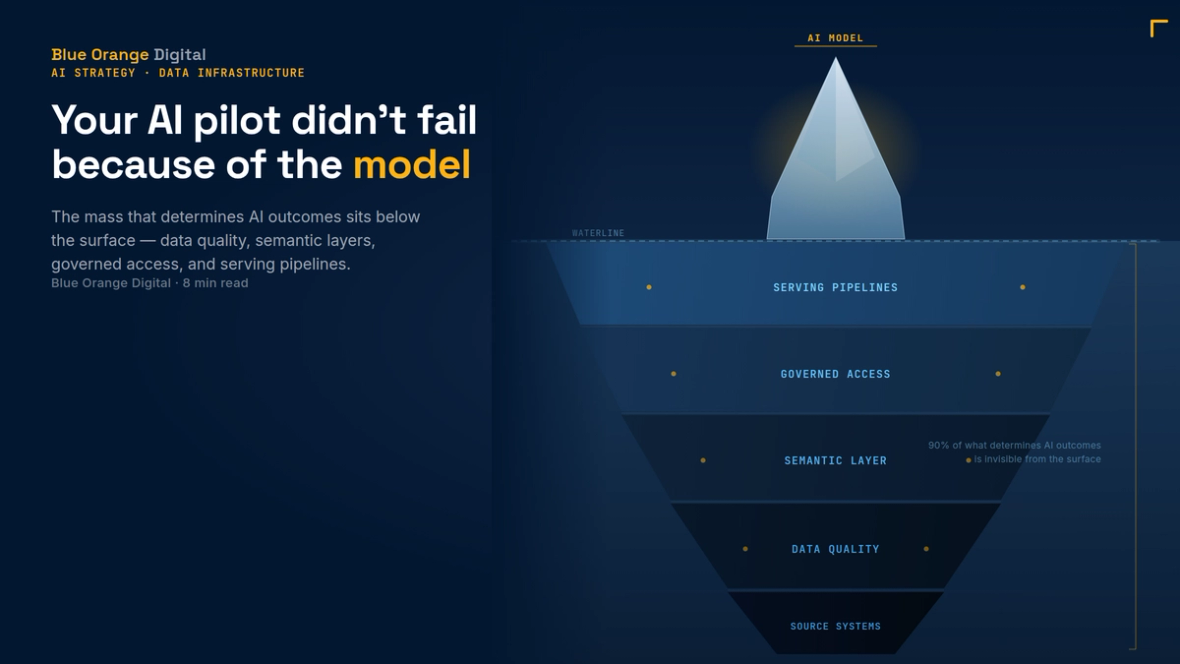
This is a story about where the leverage actually lives. In most mid-market AI initiatives we see, the model accounts for the last ten percent of output quality. The first ninety percent is determined by the infrastructure underneath it: the data that feeds it, the definitions that shape it, the governance that constrains it, and the pipelines that deliver it.
If you are running AI initiatives and not getting the results you expected, the question is not which model to try next. The question is whether your data infrastructure meets four specific preconditions for AI to work.
Precondition 1: Trustworthy data
AI models are pattern-recognition systems. They learn from whatever data you feed them, and they operationalize those patterns at inference time. If your training data is wrong, your model learns the wrong patterns. If your inference-time data is stale or incomplete, your model makes predictions from inputs that don't reflect the conditions you actually care about.
"Trustworthy" is a specific technical claim. It means your data has documented lineage (you know where it came from and how it was transformed), validated freshness (you know when it was last updated and whether that staleness matters for the decision), and measured quality (you have automated checks that tell you when something has drifted).
Most mid-market data stacks don't have this. They have data that worked for the reports the business intelligence team built and the dashboards the executive team approved. "Works for the dashboard" is a much lower bar than "works as AI training or inference data." A dashboard can survive a two-day stale metric. An AI-driven inventory replenishment system cannot.
Questions to ask about your own data:
- •Can you name the upstream source, transform logic, and last refresh time for every field your AI system uses? Not approximately. Specifically.
- •Do you have automated data quality checks (schema validation, freshness alerts, null-rate monitors) that run before your AI system ingests data?
- •When something goes wrong in a model output, can you trace it back to a specific data quality issue within thirty minutes?
If the honest answer to any of these is no, you have a data trust problem, not a model problem.
Precondition 2: A shared semantic layer
"Revenue" seems like an unambiguous term until you realize that Finance defines it on invoice date, Sales defines it on contract close, and Customer Success defines it on activation. Each team's dashboards are internally consistent. The number they hand to the AI system is different.
This is the semantic layer problem. When different systems, teams, and tools use the same words to calculate different things, your AI system learns from a signal that is partly noise. A churn model trained on Finance’s revenue definition will produce different predictions than one trained on Customer Success’s activation-based definition. The “right” model depends entirely on which definition you use consistently at inference time, and which definition the business actually cares about.
A shared semantic layer is the infrastructure that enforces consistent definitions across every downstream system. It is typically implemented as a metrics layer (tools like dbt Semantic Layer, Cube, or a purpose-built metrics catalog) that sits between your data warehouse and your consumers, including your AI systems. It is not primarily a technology choice. It is a data governance decision: you are declaring that “active customer” means one specific thing, encoded in one place, and every system will use that definition.
Without it, you are building AI systems on top of disagreement.
Questions to ask:
- •If you asked five people in different functions how they calculate your top three business metrics, would they give you the same answer?
- •When your AI system produces a recommendation, which team’s definition of the relevant metric is it optimizing for?
- •Do you have a documented, enforced metrics catalog that downstream systems, including your AI tools, are required to use?
Precondition 3: Governed, auditable access
AI systems raise the stakes on data access in two directions simultaneously.
First, they aggregate and recombine data in ways that can expose sensitive information even when no individual field is sensitive. A model with access to HR data, financial data, and CRM data can produce outputs that are effectively personal information even if the individual inputs were innocuous. The combination changes the exposure profile entirely.
Second, when a model produces an incorrect or discriminatory recommendation, you need to be able to audit exactly what data it accessed and when. Without that access record, you cannot defend the recommendation to a regulator, a customer, or your board.
Most mid-market companies have data access controls designed for human analysts: role-based permissions at the database or warehouse level, usually applied coarsely. That is not the same as governed access for AI systems. Governed access for AI systems requires roles scoped to the minimum data necessary for the specific use case, access logs that are queryable after the fact, and PII and PHI handling explicitly reviewed for the AI context. That last point matters because the AI context almost always creates new exposure pathways that existing data policies were never written to address.
Questions to ask:
- •Does your AI system have access to any data that the person consuming its recommendations would not be authorized to see directly?
- •Can you produce a complete access log for your AI system’s data queries for any twenty-four hour period in the past ninety days?
- •Has your legal or privacy team reviewed the data access model specifically for your AI use cases, separate from your general data governance policies?
Precondition 4: Serving-ready pipelines
A model that performs well in batch will fail in production when production latency requirements differ from the batch training cadence. This is the serving-readiness problem: data designed for analytical reporting (high-latency, high-volume, runs overnight) is not the same infrastructure as data feeding an AI system that makes real-time recommendations.
If your AI initiative is a recommendation engine that needs to respond in two hundred milliseconds, but your data pipeline produces feature values with a six-hour lag, the model cannot use current information. It is recommending based on what was true yesterday. In high-velocity contexts such as dynamic pricing, fraud detection, or inventory management, that gap is not a minor inefficiency. It is the reason the initiative does not work.
Serving-ready pipelines are architecturally distinct from analytical pipelines. They are built around latency SLAs, not throughput. They typically involve feature stores to pre-compute and cache feature values, streaming pipelines to reduce lag between event occurrence and feature availability, and monitoring that alerts when feature freshness degrades, not after a batch job fails.
Questions to ask:
- •What is the maximum acceptable time between a real-world event and your AI system’s access to a feature derived from that event? Do you know whether your current pipeline meets that SLA?
- •If your data warehouse were unavailable for four hours, what happens to your AI system’s ability to make recommendations?
- •Have you measured the feature freshness distribution (not just the scheduled refresh interval) for every feature your AI system uses?
The right sequencing
The model selection conversation (which vendor, which architecture, how much to fine-tune) is legitimate and it matters. But it belongs third in the sequence, not first.
The sequence that actually works:
- Establish the four preconditions above for the specific data your AI use case requires.
- Define the success criteria and the decision context: what is the AI recommendation actually being used for, and what is the cost of a wrong recommendation?
- Then select and evaluate models against data you can trust, with semantics you can defend, access you can govern, and pipelines that can serve.
Without step one, you are benchmarking models on broken data and concluding that the model is broken.
This is the diagnostic work that comes before model selection. It is also the work most organizations skip because it is less exciting than picking a frontier model and harder to present to a steering committee. Infrastructure investments do not demo well. They just make everything else work.
Where Blueprint fits
This is exactly what the Blueprint AI Readiness Assessment is designed to surface. It scores your organization across these infrastructure foundations in about fifteen minutes and identifies the gap between your current data stack and the preconditions AI needs to produce reliable results.
Blueprint is a diagnostic for the infrastructure decisions that determine whether any model choice will succeed. Most organizations come away with a clearer picture of which precondition is their binding constraint, and that answer is worth more than another six months of model evaluation.
If you are unsure where your organization stands, take the assessment at blueprint.blueorange.digital. It is free, takes about fifteen minutes, and gives you a concrete picture of where to focus before your next AI investment.