

Retrieval-augmented generation, vector databases and orchestration layers are often the first things a team asks for when it starts building with AI. They sound like the serious version. For most first use cases they're overhead: systems you'll monitor, re-index and debug for years, built for a problem you don't have yet.
When does a use case actually need RAG?
RAG earns its place when the model has to answer questions across a large body of information, queried again and again, that can't fit in its context at once. Think a document archive, a policy library or years of tickets. One document and one task rarely needs it.
Retrieval solves a specific problem: the model needs knowledge that's too large to hand it directly, so a pipeline finds the relevant pieces and passes only those in. When that's your problem, retrieval is the right tool and worth the investment.
But many first use cases look like this instead: read this contract, summarize this report, turn this CIM into a first-pass investment memo, draft a deck from this data pack. The input is one document, or a handful. Today's models hold hundreds of pages in context. There's nothing to retrieve.
Why do teams overbuild?
Because the architecture diagrams in vendor demos show every layer, and a fuller stack feels safer to approve. The cost doesn't show up at build time. It shows up later, in maintenance, drift and debugging, after the budget is spent.
There's also a reasonable-sounding argument for future-proofing: "we'll need retrieval eventually, so let's build it now." Sometimes that's true. More often the eventual need looks different from what was built, and the team ends up maintaining a pipeline nobody designed for the problem they actually have.
We see a related pattern with orchestration. A single well-scoped agent with checks in code is replaced, before it ever ships, by a multi-agent framework with routing and shared state. Each piece is defensible. Together they make a system that's harder to test than the problem required.
Every layer is a system someone has to run
Each layer you add brings its own upkeep. A retrieval pipeline needs chunking and ranking tuned. An index needs re-building as documents change. A vector database needs hosting and access control. Orchestration needs state, retries and tracing. None of it is free after launch.
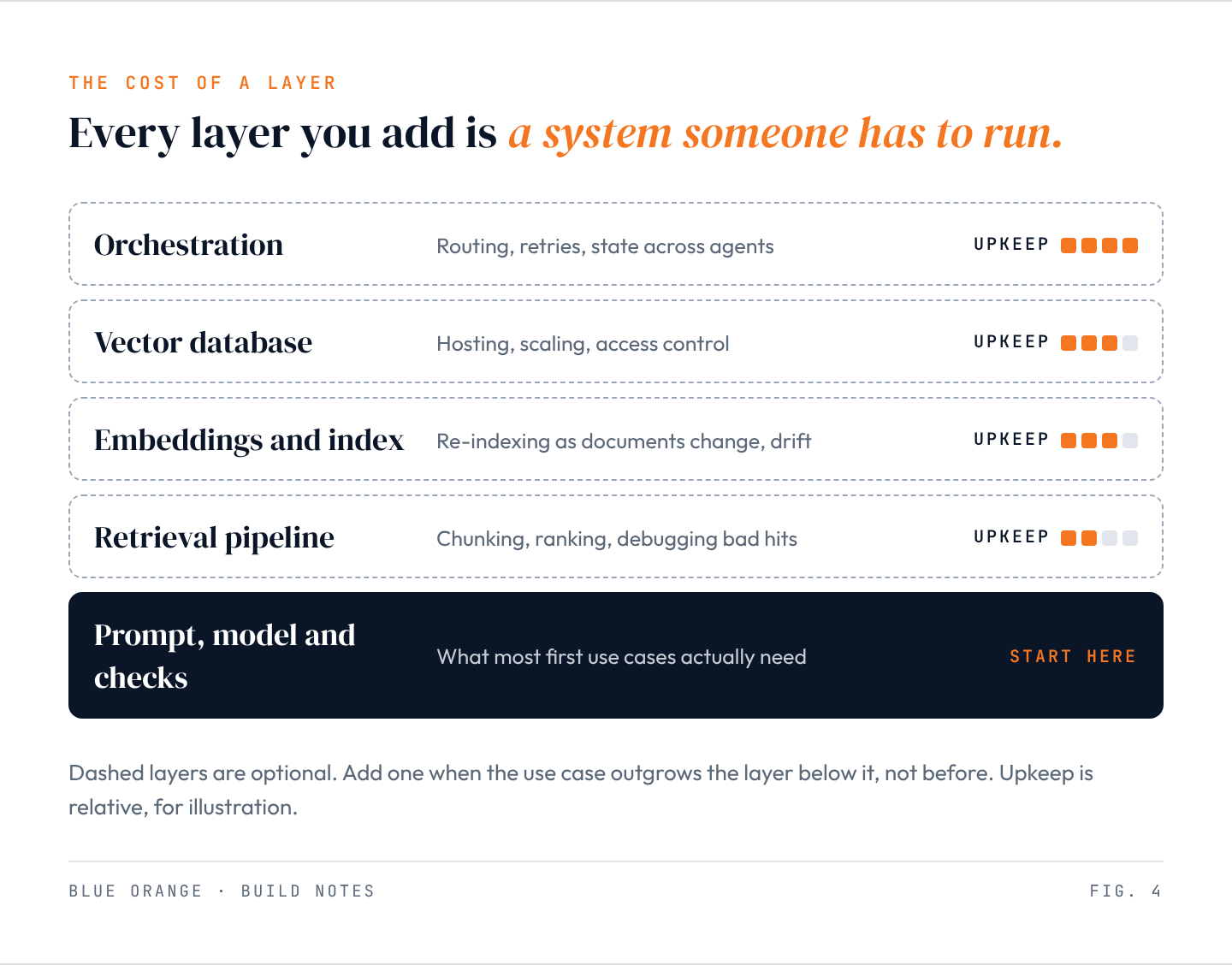
The quieter cost is debugging. When an answer is wrong in a simple workflow, you look at the prompt, the input and the output. When it's wrong in a layered one, it could be the chunking, the ranking, a stale index, a routing decision or the model. Every layer is another place for an error to hide.
That's why we say the layering is the investment. A well-built layer is portable and worth owning. It's an investment, though, only when the use case needs it. A layer you didn't need is just a cost.
The first question: does it fit in the prompt?
If everything the task needs fits in the model's context, the prompt is your architecture. Put the material in, add checks on the output, and ship. Build retrieval only when the task outgrows the prompt.
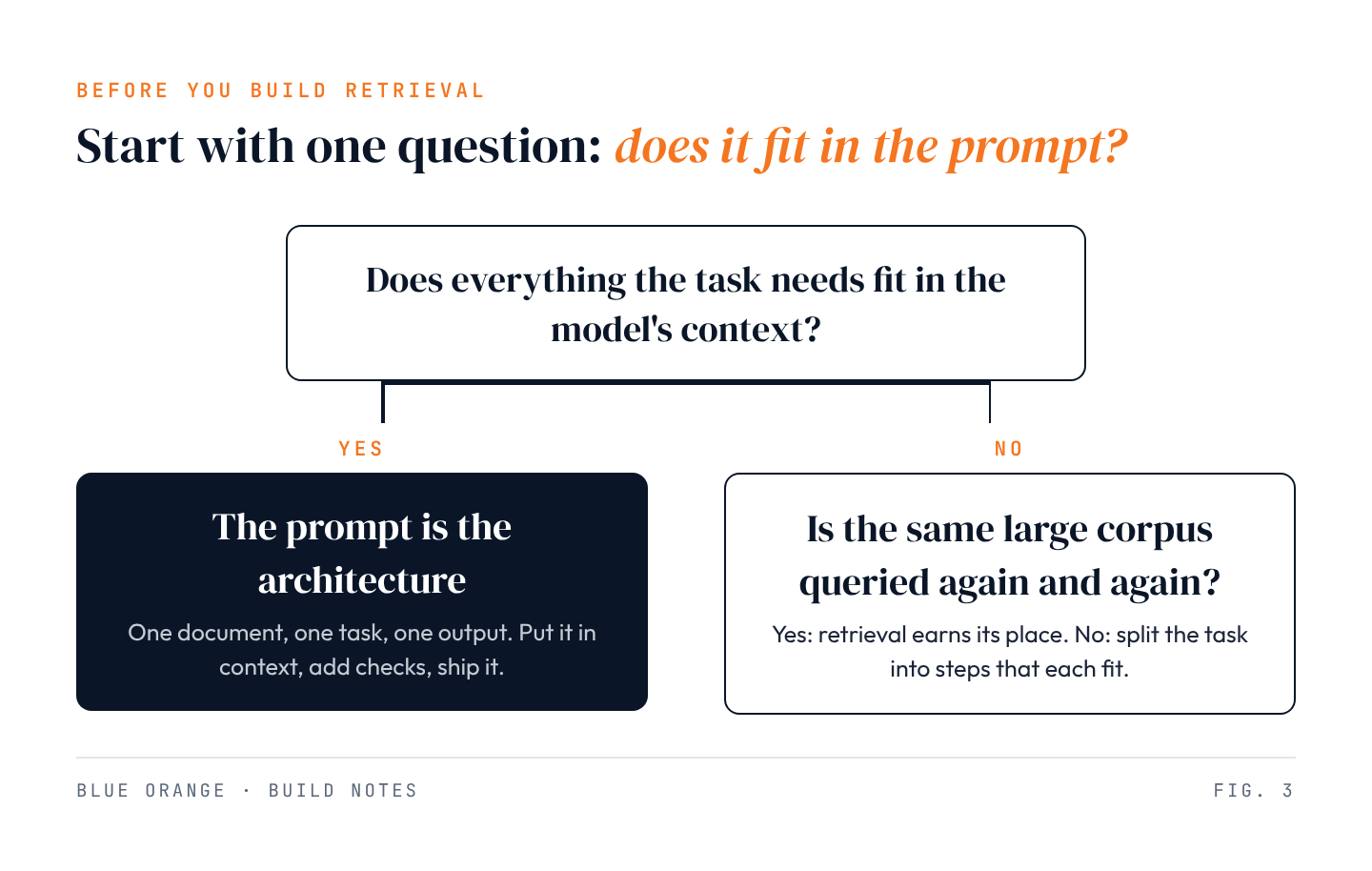
When the answer is no, there's a second question before reaching for retrieval: is the same large body of information being queried repeatedly? If it is, retrieval is justified. If the input is simply long, it's often better to split the task into steps that each fit in context, such as summarize each section and then combine, than to build a search system around a single document.
A retrieval pipeline we talked a client out of
A team asked us to scope a RAG system for a workflow that turned a long report into a summary deck. The whole report fit in the model's context, so there was nothing to retrieve. We built the workflow without it, and it shipped sooner and costs less to run.
The request made sense on paper. The team had read that RAG reduces hallucination and wanted the deck grounded in the source. But the model could already read the entire report. A retrieval step would have handed it fragments of a document it could see whole, and added a pipeline to maintain.
What actually made the output trustworthy was simpler: a fixed structure for the deck, figures pulled into a schema and checked against the source in code, and a reviewer at the end. Grounding came from checks, not from search.
When to add the next layer
Add retrieval when the material stops fitting in context and is queried repeatedly. Add orchestration when several well-scoped agents genuinely need to coordinate. In both cases, add the layer because the use case outgrew the one below it, not because the diagram had a box for it.
Signals that a use case is ready for retrieval include questions that span many documents, a corpus that changes often enough to need indexing, and answers that must cite sources across a large archive. Signals for orchestration include separate tasks with separate owners that share outputs, and a single agent whose scope is growing past what one set of checks can cover.
Until then, start with the prompt, the model and the checks. If you want a quick way to decide what belongs where in a workflow, try The Four-Line Test, and for why scope matters more than model choice, read Why AI Agents Fail in Production.