

Manufacturing leaders face an unprecedented challenge: meeting skyrocketing demand for customized products while maintaining razor-thin margins and operational excellence. The traditional playbook of incremental improvements no longer cuts it. Today's manufacturers need intelligent systems that can process vast amounts of operational data, predict problems before they occur, and optimize production in real-time.
At Blue Orange Digital, we've helped dozens of manufacturers transform their operations through practical AI implementations that deliver measurable ROI within months, not years. Let's explore how artificial intelligence is reshaping the factory floor and supply chain—and more importantly, how you can leverage these technologies today.
The Manufacturing AI Revolution: By the Numbers
The explosive growth in manufacturing AI tells a compelling story. According to recent market analysis, the AI in manufacturing sector is projected to reach $68 billion by 2032, up from just $5 billion in 2023. This isn't speculative hype—it's driven by manufacturers achieving tangible results:
- 50% reduction in unplanned downtime through predictive maintenance systems
- 90% accuracy in defect detection using computer vision technology
- 25% decrease in operational costs via intelligent automation
- 33% improvement in inventory management with AI-powered forecasting
These aren't theoretical benefits. They're real results our clients at Blue Orange Digital are achieving through strategic AI deployment.
Breaking Down the Core AI Applications in Manufacturing
Predictive Maintenance: Stop Problems Before They Start
Equipment failure is the silent killer of manufacturing profitability. A single unexpected breakdown can cost hundreds of thousands in lost production. Traditional preventive maintenance—replacing parts on a schedule regardless of condition—wastes money and resources.
Modern AI systems analyze sensor data from equipment to identify subtle patterns that precede failures. For instance, GE's Predix platform has helped manufacturers reduce maintenance costs by 20% while extending equipment life by 20%.
At Blue Orange Digital, we implement predictive maintenance solutions using platforms like Databricks to process streaming sensor data and Snowflake for historical analysis. One of our aerospace clients reduced unexpected equipment failures by 45% within six months of deployment.
Computer Vision for Quality Control
Manual quality inspection is slow, inconsistent, and expensive. Human inspectors can miss up to 20% of defects due to fatigue and subjective judgment. AI-powered visual inspection systems never tire and maintain consistent accuracy.
Consider how NVIDIA's manufacturing solutions enable real-time defect detection at production speeds. These systems can identify microscopic flaws invisible to the human eye, ensuring only perfect products reach customers.
We recently deployed a computer vision system for an electronics manufacturer that inspects 10,000 units per hour with 95% accuracy—a 3x improvement over manual inspection. The system runs on edge devices for real-time processing, with aggregated insights flowing to their Snowflake data warehouse for trend analysis.
Supply Chain Intelligence
Supply chain disruptions cost manufacturers billions annually. Traditional forecasting methods can't account for the complex variables affecting modern global supply chains—from weather patterns to social media trends.
AI transforms supply chain management by analyzing thousands of data points simultaneously. Machine learning models predict demand fluctuations, optimize inventory levels, and identify potential disruptions before they impact production.
A food and beverage client of ours implemented our AI-driven demand forecasting solution and achieved:
- 30% reduction in excess inventory
- 25% decrease in stockouts
- 15% improvement in order fulfillment rates
Real-World Success Stories: AI in Action
Automotive Manufacturing Excellence
A major automotive parts supplier partnered with Blue Orange Digital to address quality control challenges. Their manual inspection process was catching only 70% of defects, leading to costly recalls and damaged customer relationships.
We implemented an AI-powered visual inspection system integrated with their existing production line. The solution uses deep learning models to analyze high-resolution images of parts in real-time, flagging defects instantly. Results after 90 days:
- Defect detection rate increased to 94%
- Inspection time reduced by 60%
- Annual savings of $2.3 million from reduced recalls
Pharmaceutical Production Optimization
A pharmaceutical manufacturer struggled with batch variability that led to 15% of production failing quality standards. Traditional statistical process control couldn't identify the root causes.
Our team deployed an AI solution that analyzes hundreds of process parameters in real-time, identifying subtle correlations human analysts missed. The system now predicts batch quality with 92% accuracy, allowing operators to adjust parameters proactively. The client has reduced failed batches by 70%, saving millions in wasted materials.
Implementing AI: A Practical Roadmap
Success with manufacturing AI isn't about implementing every possible technology—it's about strategic deployment that addresses your specific challenges. Here's our proven approach:
1. Start with Data Foundation
AI is only as good as the data it processes. Most manufacturers have data scattered across dozens of systems. We help clients build unified data platforms using tools like Snowflake and Databricks that consolidate operational data into a single source of truth.
2. Identify High-Impact Use Cases
Not every process needs AI. We work with clients to identify areas where AI can deliver the greatest ROI—typically processes that are:
- High-volume and repetitive
- Critical to quality or safety
- Currently bottlenecks in production
- Data-rich but insight-poor
3. Pilot and Scale
We recommend starting with a focused pilot project that can demonstrate value within 60-90 days. Once proven, the solution can be scaled across facilities and processes.
4. Build Internal Capabilities
Sustainable AI success requires internal expertise. We provide comprehensive training and knowledge transfer, ensuring your team can maintain and expand AI capabilities independently.
Common Pitfalls to Avoid
Through our experience implementing AI solutions, we've identified several common mistakes manufacturers make:
Overcomplicating the initial deployment: Start simple. A basic predictive maintenance system that prevents one critical failure pays for itself immediately.
Neglecting change management: AI changes how people work. Invest in training and communication to ensure adoption.
Ignoring data quality: Garbage in, garbage out. Clean, consistent data is essential for AI success.
Expecting immediate perfection: AI models improve over time. A system that's 80% accurate today can reach 95% accuracy with continued learning.
The ROI of Manufacturing AI
The business case for AI in manufacturing is compelling. Based on our client implementations, typical returns include:
- Predictive Maintenance: ROI of 10:1 within 12 months
- Quality Control: Payback period of 6-9 months
- Supply Chain Optimization: 15-20% reduction in working capital requirements
- Production Optimization: 10-15% increase in overall equipment effectiveness (OEE)
These aren't aspirational targets—they're average results from our implementations. The key is choosing the right use cases and executing with precision.
Looking Ahead: The Future of Manufacturing AI
While we focus on practical, implementable solutions today, it's worth understanding where the industry is heading:
Autonomous production lines that self-optimize based on demand and constraints are becoming reality. Siemens' digital factory initiatives showcase how AI can orchestrate entire production facilities.
Digital twins powered by AI enable manufacturers to simulate and optimize processes before implementing changes in the physical world.
Collaborative AI that works alongside human operators, augmenting their capabilities rather than replacing them, is gaining traction.
Getting Started with Manufacturing AI
The gap between AI leaders and laggards in manufacturing is widening. Early adopters are capturing market share through superior quality, lower costs, and faster innovation cycles. The question isn't whether to implement AI, but how quickly you can deploy it effectively.
At Blue Orange Digital, we specialize in practical AI implementations that deliver measurable results. Our team combines deep manufacturing domain expertise with cutting-edge AI capabilities, delivered through proven platforms like Snowflake and Databricks.
Whether you're looking to reduce downtime through predictive maintenance, improve quality with computer vision, or optimize your supply chain with intelligent forecasting, we can help you navigate the journey from concept to production.
The manufacturing revolution isn't coming—it's here. The companies that embrace AI today will define the industry tomorrow. Don't let your competition leave you behind.
Ready to explore how AI can transform your manufacturing operations? Contact Blue Orange Digital to discuss your specific challenges and opportunities. Our team of AI experts and data engineers can help you build a roadmap to manufacturing excellence.

PE-Grade Data & AI
Assessment Platform
Blueprint gives operating partners a clear, benchmarked view of data and AI readiness across portfolio companies—in days, not months. Start with a free self-service questionnaire or connect environments for automated infrastructure scanning.
Explore Blueprint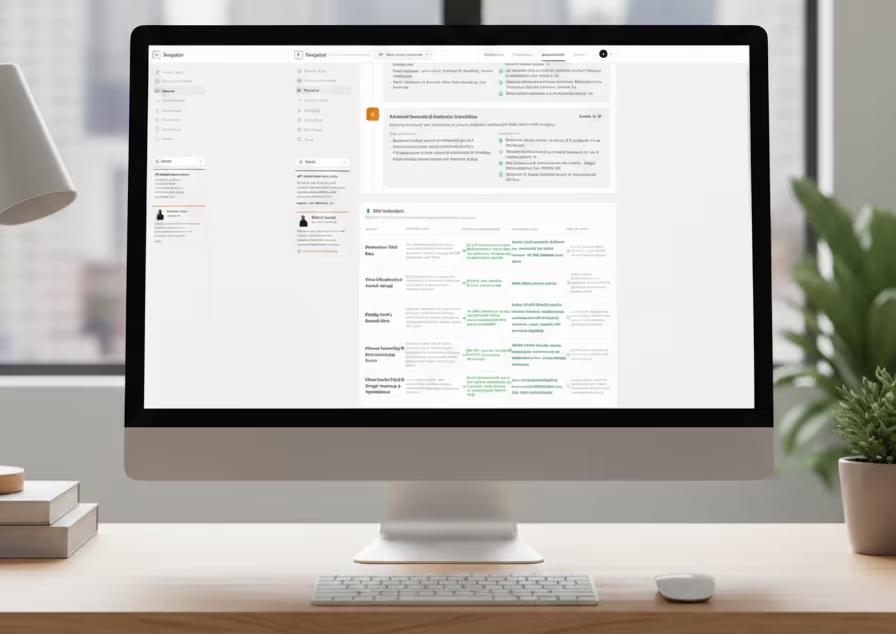
Blueprint Assess
Self-service questionnaire for rapid portfolio triage
- 10-minute guided assessment
- Benchmarked maturity scores across 6 dimensions
- Prioritized recommendations with estimated ROI
- No environment access required
- Shareable PDF report for deal teams
Blueprint Scan
Automated read-only infrastructure scanner
- Connects to Databricks, Snowflake & Azure Fabric
- SOC 2 Type II & ISO 27001 (pending)
- Zero data movement — read-only metadata analysis
- Cost optimization & architecture recommendations
- Deployment-ready modernization roadmaps