

Your data warehouse is expensive. Your data lake is a mess. The data lakehouse was built to fix both problems at once — here's how it works, when it makes sense, and how to get started.
For the better part of a decade, enterprises have lived with an uncomfortable compromise. Store your structured data in a warehouse for fast analytics — and pay dearly for it. Dump everything else into a data lake for flexibility — and watch it slowly become a swamp. Run both systems in parallel, and spend your weekends reconciling them.
The data lakehouse is what happens when the industry finally refuses to accept that tradeoff.
A data lakehouse is a unified data architecture that combines the low-cost, flexible storage of a data lake with the performance, reliability, and governance of a data warehouse — all in a single platform. It doesn't bolt two systems together. It reimagines the stack from the ground up, using open file formats, a metadata layer for ACID transactions, and query engines powerful enough to serve both your BI dashboards and your machine learning pipelines from the same copy of the data.
If you're evaluating your data architecture — whether you're modernizing from legacy systems, consolidating after an acquisition, or preparing your infrastructure for AI — understanding the lakehouse model isn't optional anymore. It's becoming the default.
Data Lakehouse Architecture: What's Actually Under the Hood
Most explanations of lakehouse architecture hand you a three-layer diagram and call it a day. That's fine for a slide deck, but if you're the one signing off on an implementation, you need to understand what each layer actually does and why it matters.
Layer 1: Cloud Object Storage (The Foundation)
At the bottom of the stack sits commodity cloud storage — Amazon S3, Azure Data Lake Storage, or Google Cloud Storage. This is where all of your data physically lives, stored in open file formats like Apache Parquet, ORC, or Apache Iceberg.
This is what makes the economics work. Cloud object storage costs a fraction of what proprietary warehouse storage charges. And because the data sits in open formats, you're never locked into a single vendor's query engine. Your data stays portable.
Layer 2: The Metadata and Transaction Layer (The Brain)
This is the layer that transforms a data lake into a lakehouse — and it's the piece most people underestimate.
Technologies like Delta Lake, Apache Iceberg, and Apache Hudi sit on top of your raw storage and add capabilities that data lakes have historically lacked:
- ACID transactions. Multiple teams can read and write to the same datasets simultaneously without corrupting data. No more "don't touch the pipeline, finance is running their quarterly close."
- Schema enforcement and evolution. The system validates incoming data against expected schemas and handles schema changes gracefully — so a new column from a source system doesn't break your entire downstream pipeline.
- Time travel and versioning. Every change to a dataset is versioned. You can query data as it existed at any point in time, roll back bad writes, and maintain complete audit trails.
- File-level indexing and statistics. The metadata layer tracks min/max values, row counts, and partition information at the file level, enabling query engines to skip irrelevant data entirely.
If the storage layer gives you cost efficiency, this layer gives you the trust and reliability that warehouse users expect. It's the reason a CFO can run their board reporting off the same platform that data scientists use for experimental feature engineering.
Layer 3: Query and Processing Engines (The Muscle)
The top layer is where compute happens. This is where the lakehouse model gets genuinely interesting, because it decouples compute from storage entirely.
A single lakehouse can serve multiple engines simultaneously — Apache Spark for large-scale data processing, Trino or Presto for interactive SQL queries, and specialized ML frameworks for model training — all reading from and writing to the same underlying data. You scale each engine independently based on workload, and you pay only for the compute you actually use.
This is architecturally different from a traditional warehouse, where storage and compute are typically bundled (or at best, semi-independently scaled within a proprietary system).
Layer 4: Governance and Security (The Guardrails)
Spanning the entire stack is a governance layer that handles access control, data lineage, cataloging, and compliance. Tools like Unity Catalog (Databricks), AWS Lake Formation, or Apache Atlas provide centralized policy management — a single place to define who can see what, track where data came from, and enforce regulatory requirements like GDPR or HIPAA.
In practice, this layer is what makes a lakehouse viable for regulated industries. Without it, you're back to the ungoverned data lake problem, just with nicer file formats.
Lakehouse vs. Data Warehouse vs. Data Lake
The distinctions matter — and they're more nuanced than most comparison tables suggest. Here's an honest breakdown:
| Dimension | Data Lake | Data Warehouse | Data Lakehouse |
|---|---|---|---|
| Storage Format | Open formats (Parquet, JSON, CSV) on cloud object storage | Proprietary formats within the warehouse engine | Open formats on cloud object storage |
| Data Types | Structured, semi-structured, unstructured | Primarily structured | Structured, semi-structured, unstructured |
| Transaction Support | None natively | Full ACID | Full ACID (via metadata layer) |
| Query Performance | Poor to moderate for analytical queries | Excellent for SQL workloads | Good to excellent (improving rapidly) |
| Cost | Low storage, but compute sprawl adds up | High — especially at scale | Low storage, pay-per-use compute |
| Schema Management | Schema-on-read (loose) | Schema-on-write (strict) | Both — enforced but flexible |
| ML/AI Readiness | Good (direct file access for ML frameworks) | Poor (data must be exported) | Excellent (native access for both SQL and ML) |
| Governance | Bolted on, often inconsistent | Built-in but siloed | Unified across all workloads |
| Vendor Lock-in | Low | High | Low to moderate |
| Data Freshness | Batch-dependent | Near real-time (with cost) | Near real-time (with streaming layers) |
The honest truth: No architecture is universally superior. A well-tuned warehouse still outperforms a lakehouse on pure SQL query latency for structured data. A raw data lake still offers maximum flexibility for experimental, schema-less workloads. The lakehouse wins when you need to do both — and when you're tired of maintaining the integration layer between them.
Key Benefits of a Data Lakehouse
Unified Analytics Across Teams
The most underappreciated benefit of a lakehouse isn't technical — it's organizational. When your data analysts, data engineers, data scientists, and business intelligence teams all work from the same governed copy of the data, you eliminate an entire category of problems: conflicting metrics, stale dashboards, and the perennial "my numbers don't match your numbers" conversation.
One platform. One version of the truth. Multiple workloads.
Meaningful Cost Reduction
Lakehouse architectures typically reduce total data platform costs by 30–50% compared to running parallel lake and warehouse systems. The savings come from three places: cheaper storage (open formats on object storage vs. proprietary warehouse storage), eliminated redundancy (no more ETL pipelines copying data between systems), and independent compute scaling (you stop paying for idle warehouse capacity).
For mid-market companies managing 10–50TB of data, this often translates to six figures in annual savings.
AI and ML Readiness
This is where the lakehouse architecture earns its place in a modern stack. Machine learning frameworks — PyTorch, TensorFlow, scikit-learn — need direct access to large volumes of diverse data in open formats. Traditional warehouses require you to extract data out of the warehouse and into a separate environment for model training, creating latency, duplication, and governance gaps.
A lakehouse serves ML workloads natively. Your data scientists access governed, production-quality data in place, using the same datasets that power your dashboards. This accelerates the path from experimental models to production AI dramatically.
Simplified Governance at Scale
Instead of maintaining separate access controls, lineage tracking, and audit logs across your lake and warehouse, a lakehouse provides a single governance framework. One catalog. One set of access policies. One lineage graph. This isn't just cleaner — it's often the difference between achieving regulatory compliance and hoping for the best.
Real-World Use Cases
Private Equity Portfolio Analytics
A mid-market PE firm with 15 portfolio companies faces a familiar challenge: each company runs different systems, reports in different formats, and uses different definitions for basic metrics like revenue, churn, and EBITDA.
A lakehouse architecture ingests raw data from every portfolio company into a shared storage layer, applies standardized transformations through the metadata layer, and serves both roll-up dashboards for the investment team and granular operational analytics for portfolio company leadership. The fund gets a consolidated view of portfolio health in days rather than the weeks it took with manual spreadsheet aggregation — and can layer in predictive models for revenue forecasting without building a separate ML infrastructure.
Fintech Fraud Detection
A payment processing company needs to analyze transaction data in near real-time to detect fraud patterns, while simultaneously maintaining historical datasets for model training and regulatory reporting.
With a lakehouse, streaming transaction data flows through Apache Kafka into Delta Lake, where it's immediately available for both real-time scoring models and batch analytics. The fraud team trains models directly on historical transaction data (including unstructured data like device fingerprints and session logs) without moving it to a separate ML environment. Compliance teams run audit queries against the same governed dataset with full time-travel capabilities.
Healthcare Data Integration
A regional health system operating across 12 facilities needs to consolidate clinical, claims, and operational data for population health analytics while maintaining HIPAA compliance.
The lakehouse ingests HL7 FHIR data, claims files, EHR extracts, and unstructured clinical notes into a single governed platform. The metadata layer enforces patient-level access controls and maintains complete audit trails. Clinical researchers access de-identified datasets for outcomes analysis while the finance team runs cost-of-care reporting from the same underlying data — without duplicating sensitive patient information across multiple systems.
Is a Data Lakehouse Right for You?
Not every organization needs a lakehouse. If you're running a single structured dataset for BI reporting and you're happy with your warehouse costs, a lakehouse migration may create more complexity than it resolves.
But if you're nodding along to three or more of the following, it's time to seriously evaluate the architecture:
1. You're running a data lake and a data warehouse in parallel. You're paying for two systems, maintaining ETL pipelines between them, and still dealing with data inconsistencies. A lakehouse collapses this into one platform.
2. Your cloud data costs are climbing faster than your data volume. Proprietary warehouse storage pricing doesn't scale gracefully. If your bill is growing 20%+ year-over-year without a corresponding increase in business value, open-format storage on a lakehouse can change the economics.
3. You have AI or ML ambitions but no infrastructure for them. Your data science team is spending more time extracting and preparing data than building models. A lakehouse gives them governed, direct access to the data they need.
4. Multiple teams need access to the same data for different purposes. Analysts want SQL. Data scientists want DataFrames. Engineers want streaming. If you're copying data across systems to serve different workloads, a lakehouse lets you serve them all from one governed layer.
5. Your governance is fragmented or manual. You're managing access controls in multiple places, lineage is incomplete, and your compliance team is nervous about the next audit. A lakehouse unifies governance under one framework.
If you checked three or more, the question isn't whether a lakehouse makes sense — it's how to sequence the migration without disrupting production workloads.
How to Get Started: A 90-Day Roadmap
Lakehouse implementations don't need to be multi-year transformation programs. A well-scoped engagement can deliver production value in 90 days:
Days 1–30: Assessment and Architecture Design. Audit your current data landscape — sources, volumes, workloads, costs, and governance gaps. Define your target lakehouse architecture, select your metadata layer (Delta Lake, Iceberg, or Hudi), and identify the first two to three high-value datasets for migration.
Days 31–60: Foundation Build. Stand up your lakehouse infrastructure, implement governance policies, and migrate your initial datasets. Build the ingestion pipelines and validate data quality against your existing warehouse outputs. This is where you prove the architecture works with your data, your team, and your workloads.
Days 61–90: Workload Migration and Optimization. Migrate priority analytical workloads — BI dashboards, scheduled reports, and at least one ML pipeline — onto the lakehouse. Performance-tune query engines, establish monitoring, and document the playbook for subsequent dataset migrations.
By day 90, you should have a production lakehouse serving real workloads, a validated architecture for scaling, and a clear cost comparison against your legacy systems.
Build Your Lakehouse With Confidence
Blue Orange Digital has designed and deployed lakehouse architectures for organizations across financial services, healthcare, and private equity — including implementations on Databricks, Snowflake, and cloud-native stacks. With 250+ platform deployments and a practitioner-first approach, we help teams move from architecture decision to production value in weeks, not quarters.
Whether you're evaluating lakehouse platforms, planning a migration from a legacy warehouse, or building AI-ready data infrastructure for the first time, we can help you get there.
Schedule a Free Data Architecture Assessment →
Explore more from Blue Orange Digital:

PE-Grade Data & AI
Assessment Platform
Blueprint gives operating partners a clear, benchmarked view of data and AI readiness across portfolio companies—in days, not months. Start with a free self-service questionnaire or connect environments for automated infrastructure scanning.
Explore Blueprint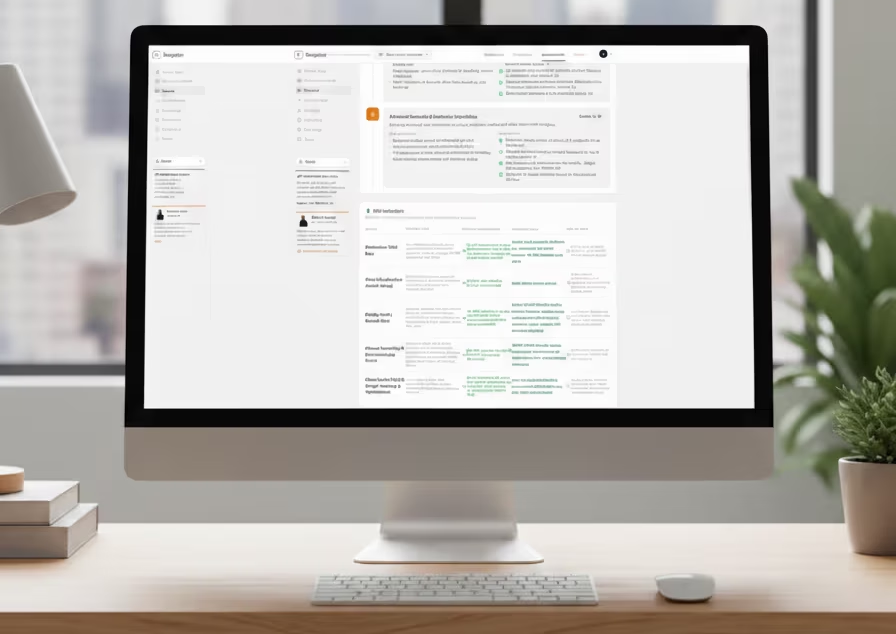
Blueprint Assess
Self-service questionnaire for rapid portfolio triage
- 10-minute guided assessment
- Benchmarked maturity scores across 6 dimensions
- Prioritized recommendations with estimated ROI
- No environment access required
- Shareable PDF report for deal teams
Blueprint Scan
Automated read-only infrastructure scanner
- Connects to Databricks, Snowflake & Azure Fabric
- SOC 2 Type II & ISO 27001 (pending)
- Zero data movement — read-only metadata analysis
- Cost optimization & architecture recommendations
- Deployment-ready modernization roadmaps